
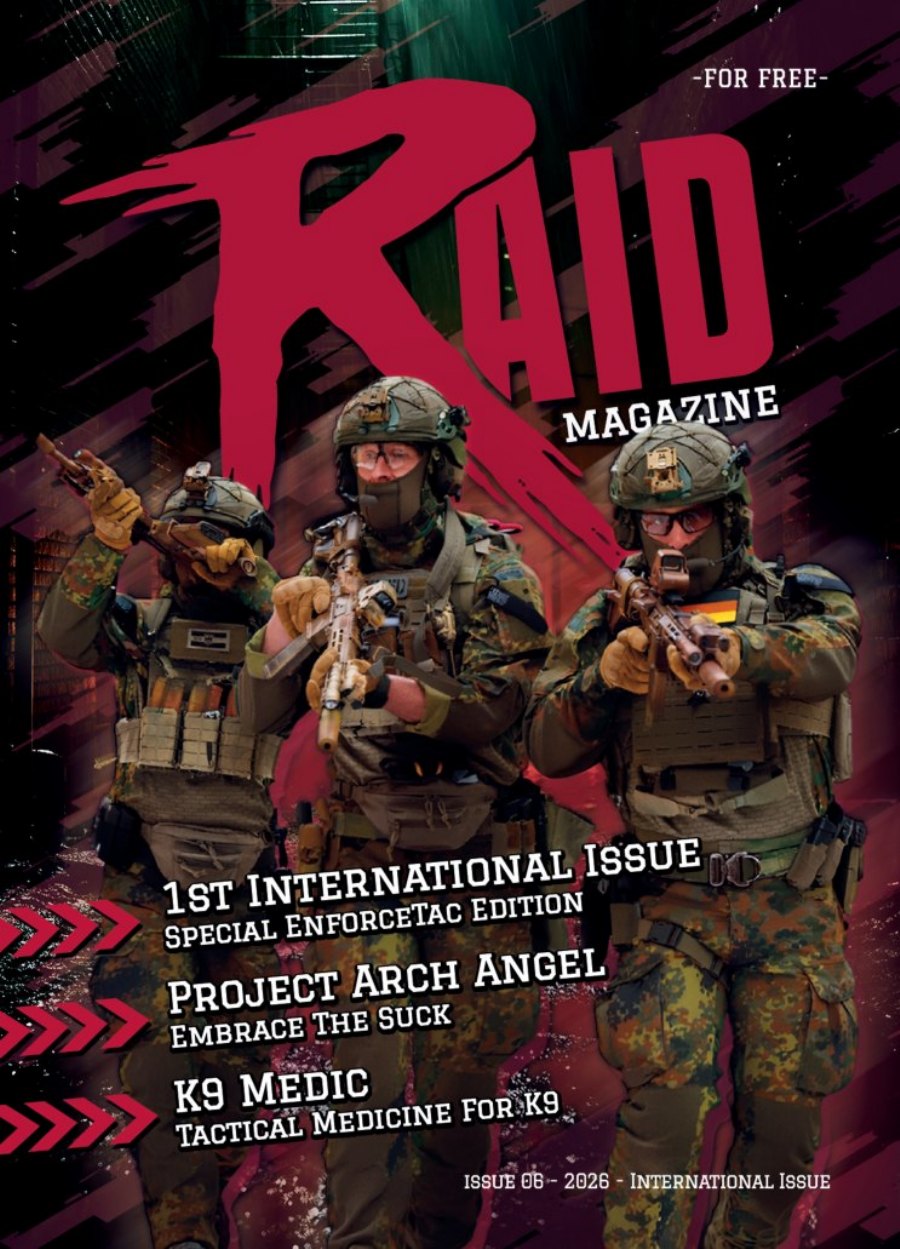
In dieser Ausgabe
- S. 4Enforce Tac Village 2025: A ReviewSzene & Events
- S. 7From KSK to transitionBundeswehr · Veteranen
- S. 8K9 Medic & K9 Medic SymposiumK9 / K9 Medic · Taktische Medizin
- S. 10The Deuser Strike BandTraining & Mindset · Ausrüstung
- S. 12The Myth of the TourniquetTaktische Medizin
- S. 14Learn to suffer without complainingBundeswehr · Training & Mindset
- S. 16Snipers in the age of persistent surveillanceBundeswehr
- S. 18Mindset forged in operational serviceTraining & Mindset · Veteranen
- S. 22Conjugate Tactical: Strongman meets tactical performanceTraining & Mindset
- S. 26Quick and Dirty: KettlebellTraining & Mindset
- S. 28Tactical Ballistic ShieldAusrüstung · Polizei
- S. 32Paratrooper in the Octagon: Patrick VespazianiSzene & Events · Training & Mindset
- S. 34Performance under pressureTaktische Medizin · Training & Mindset
- S. 36From airborne soldier to BaghdadEinsatzberichte
- S. 40How to wear your plate carrierAusrüstung
- S. 42TCCC and TECC: Tactical casualty careTaktische Medizin
- S. 44How to become a BAMBundeswehr · Training & Mindset
- S. 46Knife and violent crime: A situation reportSicherheitslage
Text der Artikel anzeigen
Der Text wurde automatisch per Texterkennung aus dem Heft erfasst und kann Lesefehler enthalten. Im Original lesen: Ausgabe 06 öffnen.
Enforce Tac Village 2025: A Review Seite 4
ENFORCE TAC VILLAGE 2025 A REVIEW Enforce Tac 2025 has grown to record levels compared to previous years. With over 19,000 visitors and nearly 1,000 exhibitors, it clearly demonstrates that Enforce Tac now ranks among the leading security trade shows in Europe. Once again this year, the Enforce Tac Village returned. The Village premiered in 2024 and proved to be a complete success. But what exactly is the Village ? It is a specially constructed urban training environment built exclusively for the trade fair. Here, exhibitors have the opportunity to present their products in realistic live scenarios. Companies can book time slots and provide their equipment and gear. An operator team then deploys these products within the Village during live demonstrations, allowing visitors to see the equipment working together in real operational contexts. The scenarios for the Enforce Tac Village were designed and executed by Operative Fahigkeiten and the ‚Airborne Medical Group, based on the equipment, clothing, vehicles, and systems provided. All demonstrations were embedded in a fictional operational setting. The operators themselves belong to these two organizations and are either former or active members of law enforcement or other security agencies. They showcase the products as integrated solutions, after which visitors have the opportunity to ask questions. >>>>>>> LEIF SANDERS // (G) WACHTMEISTER S ANDERS On an area of 800 square meters, Proreta constructed a small village with two modular training buildings inside Hall 8. On site, the scenarios were adapted to reflect realistic operational conditions. These included tactical operations in urban environments as well as casualty care for both humans and working dogs. The tactical training of the operators was conducted by the professionals from Operative Fahigkeiten, while the Airbome Medical Group delivered the tactical medical training. This also proved beneficial for the operators themselves, many of whom had not previously worked together and came from different branches of governmental security services. Over the course of seven days, training sessions lasting eleven hours per day were conducted. During this time, a cohesive team was formed that effectively represented both internal and external security operations and worked together at a highly professional level Initially, all operators trained together for five days at Operative Fahigkeiten's urban training center in Dittloffsroda. Afterwards, they continued scenario rehearsals and coordination at the training grounds in Nuremberg together with role players. In total, 17 operators and actors, along with one dog, participated to conduct three live demonstrations per day. Behind the scenes, a dedicated media team led by Waldfein documented the scenarios. All demonstrations were streamed live to screens across the exhibition. Some operators wore body cameras, additional camefas were installed throughout the Village, and the Stream 1 camera crew accompanied the scenarios directly. This allowed spectators to follow every aspect of the action from multiple angles. Throughout the year, videos from the ET Village are published on social media, providing exhibitors with significant ongoing media exposure. The steadily increasing numbers reflect the success of Enforce Tac, which has grown from a small forum alongside IWA into an independent and highly successful professional trade exhibition. 2023: approx. 7,000 visitors & 540 exhibitors 2024: nearly 12,000 trade visitors & 730 exhibitors 2025: over 19,000 visitors & 998 exhibitors 2026: LOADING! The Enforce Tac Village, as a major crowd-puller, plays a consistent role in this success The Airborne Medical Group and Operative Fahigkeiten are already looking ahead to 2026. The Enforce Tac Village will return once again — bigger and offering even more possibilities. =NFORC= TAC Stay tuned.
From KSK to transition Seite 7
>>>>>>> WALDEMAR DINGES //{@) THATS.VALDE From the outside, it may look like a straight line: soldier, elite unit, leadership, transition. But the reality is more layered, more human. The joumey into Germany's Kommando Spezialkrafte (KSK) - the country’s most elite militaryThey Try force — is not one you stumble into. You fight for it. You suffer for it. And most importantly, you grow through it. The infamous Hell Week during selection? Absolutely justified. That's where the wheat gets separated from the chaff. Not because of brute strength - but because of what happens in your head. The ability to stay clear under pressure, to decide, to endure. That's what counts. That's what lasts. People often ask about the brotherhood. The truth is: still have great connections with a handful of teammates. But not with most. At the end of the day, it’s a job. And that’s okay. You're bonded by shared missions, but life eventually moves on. And so did I Freedom and self-determination — these were always non-negotiable values for me. That's why kept going my way, even after the uniform. live by Stoic principles: don't let what can't control get to me. That mindset has carried me through injuries, transitions, and personal storms. Discipline, for me, means doing what needs to be done — not just when it feels right, but especially when it doesn't. It's about keeping your eyes on the long-term goal, and acting accordingly, day by day. I've always been an athlete. Injuries followed me: muscle tears, meniscus issues, ligament damage, a serious neck trauma. Doctors told me I'd never compete again. They were wrong — every single time. Even after tupturing my Achilles tendon, was back on the competition floor within months. It's not talent. It's will. And it's work, After leaving the military in September 2024, began a new chapter: consulting in the defense industry, training Bundesliga athletes, supporting organizations in their leadership culture. still serve — just in different ways. But the most meaningful role I've taken on? Fatherhood. It sounds cliché, but it changed everything. I'm convinced can have more impact on my kids than ever could have as a soldier for my country. And that's why made the decision to step out - and step up at home. Success, to me now, means balance. Still being driven, still executing — but not forgetting to enjoy the silence in between. Moving forward, no matter how turbulent the times. To young men finding their way: explore, test yourself, let life shape you — but don't chain yourself to an identity that no longer fits. And to the veterans out there: give the next generation space to discover their own strength. Don't hand them everything. Let them eam it. I'm always on the lookout for meaningful projects that align with these values. If you read this and something resonates — let's connect. Valde
K9 Medic & K9 Medic Symposium Seite 8
KD MEDIC & KI MEDIC SYMPOSIUM Your dog would take a bullet for you. Are you prepared to save their life when it counts?* - Marc Zierden - Tactical Medicine for the K9 Tactical medicine is commonly associated with human emergency care in high-risk environments such as military and law enforcement operations. But K9s operating alongside their handlers face the same threats—and require the same level of preparedness. Tactical K9 medicine focuses on immediate, life-saving interventions for dogs operating in hostile or austere environments, where time, resources, and safety are limited. Why Tactical K9 Medicine Matters Working dogs—police K9s, military working dogs, search and rescue dogs, and hunting dogs operate under extreme physical and environmental stress. Gunshot wounds, blast injuries, lacerations, and heat or cold exposure are real operational risks. Tactical K9 medicine: bridges the gap between injury and veterinary care by emphasizing: - Immediate lifesaving care - Rapid decision-making under stress - Efficient evacuation:and handover K9 First Aid Priorities Every handler and operator must master the fundamentals of K9 emergency care. The core priorities follow a simple, proven sequence: Muzzle — Bleeding Control - Secure the Airway - Keep the K9 Warm >>>>>>> MARC ZIERDEN. // (@) AIRBORNEMEDICALGROUP Muzzle / Bite Protection Before any treatment begins, apply bite protection for self-safety. Critical reminder: Under extreme stress or pain, even a well-trained dog may lose friend-or-foe recognition. Bleeding Control Uncontrolled hemorrhage is the leading cause of preventable death. - Apply direct pressure or a pressure bandage - Use a tourniquet (e.g., SWAT-T) if required -.For massive hemorrhage near the torso, wound packing may be necessary Airway Management Assess breathing immediately. If respiratory distress is present, inspect and clear the airway as needed. Thermal Management Hypothermia kills. Especially in cases of severe bleeding; maintaining body temperature is essential, as heat loss impairs clotting and accelerates shock. Training and Readiness Tactical K9 medical training must be an integral part of Operational education. Skills must be trained under realistic conditions stress, time pressure, and limited equipment. Scenario-based training builds: - Muscle memory - Decision-making under stress - Confidence when seconds matter Handlers and civilian dog owners alike should be familiar with basic and advanced K9 first aid. Preparedness is not optional it is responsibility. Conclusion Tactical K9 medicine saves lives. With proper training, the right equipment, and a clear treatment algorithm, preventable deaths can be avoided. Continuous education ensures that when a K9 goes down, the handler is ready to act decisively and effectively. Because our dogs don't hesitate. Neither should we. MPOSIUM K9 Medic Symposium 2026 — For Our K9 On August 25-26, 2026 (Tuesday & Wednesday), the K9 Medic Symposium will take place for the third time in Bad Ems, Germany. This professional event is fully dedicated to advancing medical care for working dogs. Two full days. One mission: Practical. Evidence-based. Operationally focused. Participants can expect: - Live medical demonstrations - Expert lectures from experienced practitioners - Hands-on workshops - Exhibitors from the K9 and medical sectors The symposium emphasizes interdisciplinary exchange and real-world applicability. An Icebreaker Evening on August 25, 2026, at approx. 1900 hrs, opens the event and provides an opportunity for networking within the K9 and medical community. Tombola - Giving Back Arecurring highlight of the symposium is the tombola In the previous year, prizes exceeding €2,500 were awarded. 100% of the proceeds (after event costs) are donated transparent and directly to organizations actively supporting dogs. The K9 Medic Symposium is designed for everyone responsible for dogs who want to expand their medical competence. - For Our K9 - Registration & Information: www.airborne-medical-group.com
The Deuser Strike Band Seite 10
‚At first glance, the Deuser Strike Band appears simple. Yet for those of us who wear a uniform, it is far more than an elastic training device. It is a symbol of responsibility, discipline, and commitment to being operationally ready at all times. Anyone who wears a uniform, whether in public service, emergency response, security professions, or voluntary organizations, knows that physical fitness is not an option but an obligation. This is precisely where the Strike Band demonstrates its particular strength Its greatest advantage lies in its radical simplicity. No electricity, gym, or training facility is required. The band fits into any pocket, any service vehicle, and any locker. It weighs almost nothing, takes up minimal space, and is always ready for use. Anyone carrying a Strike Band effectively carries a personal mini gym. As a result, one of the most common excuses immediately loses credibility: I can't train today because don't have the equipment. With the band, there is no lack of opportunity, only a lack of determination. Text by Mike Diehl, former SOF-soldier and brand ambassador >>>>>>> TRIPLE ACTION //(@) DEUSER.STRIKE.BAND // WWW.STRIKEBAND.DE Training thus becomes possible anywhere: in accommodation facilities, readiness rooms, between shifts, while traveling, at duty stations, or outdoors in nature. Even during long standby periods or extended shifts, short and effective training sessions can be integrated. Pulling exercises for the back and shoulders, pushing variations for the chest and arms, resisted squats, core training, and stabilization exercises are all possible. The band enforces controlled movements and allows both foundational conditioning and meaningful strength stimuli. For uniformed personnel who must perform in unpredictable and demanding situations, this is an invaluable advantage. This becomes particularly evident in the context of voluntary service, for example in organizations such as mountain rescue units, which stand as representatives of all women and men who voluntarily dedicate their time and strength to serving society. Those who carry out rescues in difficult terrain, support search operations, or provide first aid under adverse conditions cannot afford weakness. ‚An injuted person does not become lighter simply: because preparation was neglected. An operation does: ‘Not wait until one feels rested. Reality:demands robustNess, stability, endurance, and the ability to act safely under strain. The Strike Band.can be used even under the most basic conditions, in a hut, at a vehicle, in a parking area before deployment, or at the edge of a training ground. It serves as a reminder that being fit is a promise we make to others. For all uniformed professionals, one principle applies: Operational readiness does not begin in an emergency. It is built every day, in every training session and in every moment in. which we refuse to accept excuses. A lack of time jis often merely a convenient justification. With the Strike Band, five to ten minutes are sufficient to activate key muscle groups, relieve tension, or enhance physical resilience. It is a training partner that sets no conditions and accepts no excuses. Carrying it is a statement of attitude. range gan? The band does not replace comprehensive training, but it eliminates the greatest obstacle of all: the excuse of being unable to train. It conveys a clear message, particularly relevant for uniformed professionals and volunteers alike. Readiness is not a state but a decision. It does not require perfect conditions, only the willingness to assume responsibility for oneself, for the team, and for the people who rely on us. The Strike Band reminds us every day that strength does not arise from equipment, but from mindset. It is this mindset that determines whether we prevail when it truly matters. STRIKE BAND,
The Myth of the Tourniquet Seite 12
THE MYTH OF THE TOURNIQUET Massive extremity hemorrhage immediately triggers a familiar mental image: first a pressure bandage, then another one on top, and the tourniquet as a last resort. In reality, however, tourniquet application is not the end of the rescue chain—it belongs right in the center of it Simply speaking: the tourniquet is not the villain The Facts Since around 2016, German professional medical societies such as the German Society of Anesthesiology and Intensive Care Medicine (DGAI) have explicitly recommended the prehospital use of toumiquets. At the same time, organizations such as TREMA and the German Society for Trauma Surgery have stated a Clear advocacy for the usage outside the operating room. In cases of knife attacks or traumatic amputations, the topic is no longer theoretical (for further information see the guidelines for polytrauma-and severe injury management). A blood loss of approximately 1,000-1,500 ml is considered critical (life threatening) . This includes any bleeding that is flowing, spurting, pulsatile, or heavily dripping which can rapidly become life-threatening. In such situations, a simple principle applies: Hands on red — then consider the tourniquet. If pressure dressings: or direct compression fail, rapid transition to tourniquef application is mandatory. Indications & Timing A tourniquet is immediately indicated for clearly defined injury patterns: amputations, proximal extremity injuries with:spurting or pulsatile bleeding, or when a pool of blood forms and pressure alone is no longer sufficient. Time is a crucial factor: Studies show that tourniquet application for less than two hours is generally associated with a low complicati- ‘on rate. Longer durations increase the risk of ischemia, tissue necrosis, and muscle or nerve damage. >>>>>>> MARC ZIERDEN. //(@) AIRBORNEMEDICALGROUP Risks & Myths The common myths: Tourniquet equals loss of the limb or only a measure of last resort. The reality: When applied correctly, the risk is low—but not zero. Today, the tourniquet is an integral part of modern first aid. It represents a life-saving immediate intervention for massive extremity bleeding. In countries such as the United States and the United Kingdom, its usage has long been embedded in programs like "Stop the Bleed or Catastrophic Bleeding First Aid. Saving a life takes absolute priority. Anyone who stops massive bleeding with a tourniquet may have to accept the possibility of rare secondary injuries. Life before limb. Under German law ( 34 Criminal Code - justifying necessity), this approach is legally protected: preserving life outweighs the risk of potential tissue damage. Ignorance creates danger - Knowledge saves lives For this reason, we recommend repeating first-aid training every 3-5 years, with a stronger focus on hemorrhage control and the correct usage of tourniquets.
Learn to suffer without complaining Seite 14
LEARN TO SUFFER WITHOUT COMP, INING Introduction Learn to suffer without complaining (Leme Leiden ohne zu klagen) is more than a slogan. It is the motto of the German Kampfschwimmer unit and a principle deeply embedded in mental toughness and warrior culture. It closely resembles the English expression ,embrace the suck", a phrase commonly used in military units and demanding physical training programs around the world. Both statements point to the same core idea: hardship is inevitable, but how you deal with it determines whether it weakens you or makes you stronger. This mindset is not about glorifying pain for its own sake. It is about developing inner discipline, emotional control, and resilience under pressure. Accept Pain Instead of Fighting It Pain, discomfort, and adversity are unavoidable parts of life. Every human being will face situations that are unpleasant, frustrating, or outright exhausting. Many people respond to these moments with resistance, frustration, or complaint. They mentally fight the pain, wishing it away, resenting it, or feeling sorry for themselves. Yet this reaction rarely helps. In fact, it usually makes the experience worse. Consider a simple example: a cold shower. The cold water is uncomfortable the moment it touches your skin. That fact cannot be changed. What can be changed is your response. If you tense up, curse the cold, and mentally exaggerate how terrible it feels, the discomfort intensifies. If instead you accept the sensation, control your breathing, and relax your body, the cold becomes manageable. The pain ‘remains, but your suffering decreases. Pain or in this case, the cold can also be a teacher. It offers a lesson in how to manage adversity without losing control. always found it helpful to reframe unpleasant situations "as: voluntary training sessions, consciously chosen to develop resilience, discipline, ‘and mental skills, rather than as irritating events impo- 'sed.on me from the outside. This shift in perspective tums discomfort into a tool instead of an obstacle. stopped asking why it was hard. started asking what it was training. >>>>>>> MICHAEL STRAUCH // (@) PROJECTARCHANGEL That said, this is not the only valid approach. Some situations demand that discomfort be pushed out of conscious awareness altogether. By deliberately focusing attention elsewhere, the sensation can fade into the background. This method is often superior when attention must remain fully on immediate action for example, during drills or real-world scenarios involving incoming enemy fire where focusing on pain would be not only unhelpful, but dangerous. The same principle applies to physically demanding tasks such as long marches with heavy equipment, intense training sessions, or exhausting workdays. Complaining does not reduce pain. Negative thoughts focus your attention on the discomfort and drain your mental energy. Acceptance preserves strength and keeps you functional. Avoid Self-Pity and Complaining Complaining comes in two forms: intemal and external. Both are harmful Internal complaining is self-pity. It is the constant inner dialogue that repeats how unfair, exhausting, or overwhelming everything feels. This mindset weakens resolve and consumes the energy needed to endure. External complaining is verbal. It spreads negativity to others. In a team environment, one person complaining out loud can undermine morale and mental strength across the entire group. Complaints are contagious, and so is weakness. ‚A useful rule is this: if a situation cannot be changed, accept it and adapt. If it can be changed, take action. But do neither with complaints: Embrace the Suck True mastery lies not just in enduring hardship, but in actively accepting it. Instead of passively suffering, consciously experience the moment. Imagine marching through rain, muscles buming, fatigue setting in. Rather than resisting, you observe. You feel the rain, hear your breathing, sense your body working. The suffering becomes purposeful. The moment becomes training. This approach applies to every area of life: exams, difficult conversations, demanding projects, or personal struggles. Resistance creates friction. Acceptance creates clarity. The Power of a Smile One surprisingly effective tool against pain and stress is smiling even when it feels unnatural. During a training stress test, we were required to hold heavy sandbags overhead until failure. Pain escalated quickly. Then the instruction came: Smile at each other. The result was immediate. We lasted longer. Body language influences the nervous system. A forced smile can shift hormonal responses and reduce perceived pain. The body often leads the mind. Conclusion Learn to suffer without complaining. Pain is inevitable, but suffering is optional. Accept discomfort as part of the process. Control your reactions. Avoid self-pity and negativity. Smile when it hurts. Not because it is easy but because you are still in control. In doing so, you build mental toughness and resilience. The next time you face cold water, exhaustion, or adversity, remember: you can resist and suffer or accept and grow. Mike holds a master's degree in psychology and has extensive experience in tactical and remote area medicine, as well as international operational experience as a personal protection specialist in hostile and non-permissive environments. He combines psychology, functional training, tactical medicine, and stoic philosophy into a modem wamor system designed for performance, resilience, and self-mastery under pressure.
Snipers in the age of persistent surveillance Seite 16
SNIPERS IN THE AGE OF PERSISTENT SURVEILLANCE >>>>>>> TRUNK Hoss // (G) TRUNKHOGS The Grey Zone The question of whether snipers remain relevant is. raised regularly. The answer remains yes. What has fundamentally changed is the space in which they operate. The war in Ukraine illustrates that today’s battlespace is deep, fragmented, and under near constant surveillance. Classical front lines are dissolving, between them emerges a broad grey zone in which movement is risky and sustained presence is rarely possible. This grey zone consists of isolated positions, minefields, obstacles, and persistent observation. Drones monitor this space almost continuously. Movement is possible, but rarely unobserved. Effects are achieved less through direct fire engagements and more through delay, fixation, and the denial of movement corridors. Time and Relevance For snipers, this means that time is no longer protection. Prolonged presence creates patterns and increases detectability. The objective is therefore to remain of low relevance to the enemy for as long as possible. Traditional assumptions such as long dwell times, optimal camouflage, or immediate displacement after firing are increasingly unreliable. Positions often become compromised after short periods of use. As a result, positions are employed differently. Prefefence is given to hardened, pre existing structures that provide protection against indirect fire and do not generate new signatures. Improvised hides without sufficient protection are losing relevance. Position areas may be prepared, vacated, and reoccupied later. Reconnaissance and the handling of mines and explosive hazards remain routine tasks, a8 movement corridors in the grey Zone are heavily canalized and often mined. The decisive factor is not perfect concealment, but limited exposure time and low relevance: Fire-and Effect The role of firing has also changed. Confirmed kills are ‘no longer the primary measure of effectiveness. Any deliberate shot, or even clear identification through observation, can trigger rapid countermeasures, ranging from artillery fire to FPV drones. Effects are directed not only against confirmed positions, but also against suspected ones. ’ Consequently, the use of fire is deliberate and restrained. Shots are therefore often employed for area’ denial. Targeted fire forces the enemy into cover, disrupts movement, and blocks key terrain. The objective is not necessarily destruction, but shaping enemy behavior. A single sniper can deny movement corridors without permanently holding ground. Technology and Terrain These realities are reflected in equipment and technology. Modem systems aim to reduce decision times and physical presence. Combined day and night optics, thermal imaging, and computational fire control support short engagement windows. Multispectral signature reduction is increasingly important, not to achieve invisibility, but to delay detection and prioritization. Technology does not provide security, it buys time. Even though the effectiveness of drones and sensors depends on terrain, weather, and enemy capabilities, military planning must assume that this technological development is not reversible and will continue to shape future battlespaces. Movement is therefore limited and event driven. Weather and visibility remain critical factors, as fog, precipitation, or strong winds can degrade drone effectiveness and sensor performance, opening temporary windows for movement. Urban areas remain relevant, but they are not inherently favorable. Dense construction can complicate surveillance, yet quickly becomes a trap once a position is identified. More advantageous are urban fringes, industrial zones, and transitional areas, particularly where usable underground infrastructure exists. These environments offer protection, reduced observability, and viable infiltration and exfiltration options compared to dense inner city areas. Persistent surveillance shifts the sniper’s role from the pursuit of invisibility to the disciplined management of exposure, time, and space.
Mindset forged in operational service Seite 18
>>>>>>> CHRISTOPHER WAGNER // CHRISWAGNER.OFFICIAL The mindset forged in operational service is the perfect foundation for civilian life. Why? Because we never lemed to see performance as optional to us, it's a duty. I've always enjoyed the fight. For me, many things came naturally. But it's more than personal preference. For many civilians, motivation is a constant struggle: leaming new skills, breaking routines, fighting that inner resistance. For us, it was different. In operational units, everyone knows one thing: lives depend on your performance. That kind of clarity shapes you and it never really leaves. Today, as an entrepreneur, see this mindset again and again as the decisive difference. Many former operators and agency professionals share the same intemal code that sets us apart: reliability, consistency, accountability. And yes — also the willingness to embrace the fight, whether in operations or later in business. Leadership is never accidental. In the field as in civilian life, the more critical the situation, the clearer the leadership must be. Discussion is important. Creativity matters. But in the end, success doesn't come from endless debate circles it comes from results. When things get serious, clarity beats consensus. Not the longest discussion wins, but decisive leadership. One leads. The others follow. Everyone. stays sharp and ready to step up at any second. Call it one level up, call it "be prepared. We know it from war. Because you work with redundancies. Because people get injured. Because soldiers die. And someone must immediately take over eamlessiy. Once this mindset grows inside a team, extraordinary things become possible. Not for ego. Not for show. But because it's the only way to strike together when it truly matters. Amateurs talk tactics. Professionals talk logistics. And assault is a lifestyle. Theory and tactics matter no question. But at some point, it's not about what looks good on paper. It's about execution. Without logistics, the best tactics are just exercises. Without a functioning supply chain, you're left with training stories that don't hold up in reality. Assault is different. It's upright. Direct. Final. It forces decisions and consequences. It can be patient and calculated. But eventually, action decides everything. And you have to like that speed. That efficiency. That immediate feedback. Assault is a lifestyle. The same applies in business. The longest presentation doesn't win. The team that acts decisively does the one that organizes resources properly and seizes the moment. ‚Communication is another factor. Back then, and even today, constantly switched roles. remember standing in embassies countless times, wearing’ suits, perfectly formal, respecting every rule of etiquette. Every word measured. Every gesture controlled. But when things escalated, none of that mattered. No diplomacy. No small talk. Just pure emergency response The suit disappeared. 5.11 pants. Flannel shirt. No long sentences just clear, direct commands. That ability to switch instantly — that's something we were trained for. And honestly, something we were always ready for. People often ask why operators are so adaptive. Why we always try to make things possible. This mentality has pros and cons. Even today, struggle to say no to a new idea, a deal, or someone asking for help. Let's figure it out is almost a reflex. While others are still debating whether something might work, we're already planning and running scenarios. Sure, mistakes happen. That's normal. But one thing never happens: paralysis. No resignation. No helplessness. That drive clearly comes from my time as an operator. And it connects all of us who walked that path. So let me be clear: Operators are far more than the cliché citizens in uniform. First responders and service members are versatile, capable, and exceptionally trained. They bring skills that are often underestimated in civilian life until you see them in action. When look at what many of my former teammates became, it proves the point. Entrepreneurs. Aerospace specialists. CEOs. Leaders of small and mid-sized companies. Experts in government and industry. Not because their resumé alone proves anything but because the hunger for growth, change, and success never stops. And one more thing: Camaradery is something special. It carries you through operations. And it stays, even when life takes you different directions. And damn YEAH still miss it. So to the old ones, the young ones, the former ones, and those who want to become one: Stay sharp. Stay hungry. Stay dangerous.
Conjugate Tactical: Strongman meets tactical performance Seite 22
CONJUGATE TACTICAL >>>>>>> EVA DEUTSCH //(@) EVADEUTSCH.GERMANGRIT How Strongman Training Meets Tactical Performance Demands - My name is Eva-Maria Deutsch. I'm 29 years old, 1.64 m / 54 short, and depending on the season weigh between 70-75 kg / 1541b-165lb. work full-time as a criminal police officer in Germany but I'm also the current German Strongwoman Champion. To get an idea of the demands... e.g. deadlifted 165kg 6 times within 60 seconds. In 2025, placed 10th at the Natural Strongwoman World Championships (-73 kg), competing in a fully drug-tested field. In 2024, completed my first 50 km ultramarathon without any specific endurance preparation Between summer and winter 2023, participated in a 20-week tactical selection and qualification course within a specialized police unit. The physical standards were identical for men and women. There are no women within this unit. Long story short - didn't pass because of tactics and was sent home in the very last week. However managed to meet all physical as well as shooting and hand-to-hand combat demands. In 2024, my partner Maximilian Millmann and also won the Greenlight Battle, a functional fitness competition designed for tactical professionals. And yes like everyone these days we've done HYROX as well, finishing a team race in 1:07 h. So how does one body manage to meet such seemingly contradictory performance demands? The answer isn’t doping. The answer is GPP: General Physical Preparedness. Developing GPP is one of the central pillars of the Conjugate Method, and it is exactly why tactical athletes can benefit enormously from this system. The: Conjugate Method: Built for Strength Adapted for Operators Originally developed by Louie Simmons, founder of Westside Barbell, the Conjugate Method was designed to build elite powerlifters — but quickly expanded into athletic populations across speed, combat, and strength-based disciplines. Professional fighters were among the first to recognize its potential. Today, Conjugate-based programming exists for virtually any athlete who depends on high-level strength and resilience. Given its focus on raw, functional force production, it was only a matter of time before the tactical community adopted these principles. Simmons eventually tasked a group of his coaches with tailoring the method specifically for operators. Conjugate Tactical was born. At its core, the Conjugate Method is built on several key principles: 1. All Strength Qualities Are Trained Concurrently Unlike linear periodization - Block 1 hypertrophy, Block 2 maximal strength, Block 3 power/peaking the Conjugate system develops all strength qualities in parallel. Maximal strength, explosive power, hypertrophy, and work capacity are trained within the same week. 2. Max Effort Method (ME) Goal: Development of absolute strength in the 1-3 rep range (occasionally up to 5), along with maximal neural efficiency. Heavy loads condition the central nervous system to tolerate extreme strain. Movements are rotated every 1-3 weeks to prevent accommodation and plateaus. For tactical athletes, the goal is rarely to peak one specific lift, as in powerlifting. Instead, the objective is to strengthen movement pattems — for example, the ability to move heavy loads overhead under fatigue. Exercise variation is therefore essential. 3. Dynamic Effort Method (DE) Goal: Development of explosiveness and rate of force production. Principle: Strength is useless without speed. Loads of roughly 40-60% of maximum are moved with maximal acceleration and short rest periods. The focus is on violent intent, perfect execution, and fast force output. 4. Repetition Effort Method (RE) Goal: Structural resilience, hypertrophy, tendon and ligament strength, and injury prevention. Training occurs in moderate to high rep ranges, pushed close to muscular failure. The underlying concept is simple: Muscle is the body's natural armor. Within Conjugate, these assistance movements are not secondary — they are referred to as special exercises, emphasizing their strategic role. Weak links are attacked systematically, overall GPP is elevated, and durability is built from the ground up. What Defines Conjugate Tactical Two characteristics become immediately clear: 1. The system does not train exercises it trains physical qualities. 2. Training is weakness-driven deficiencies are eliminated relentlessly. Conjugate Tactical is not merely a strength program. Its foundation is GPP: The ability to perform at a high level anytime, anywhere, under imperfect conditions. Why Strongman Is the Missing Link for Tactical Athletes Beyond barbell work, Conjugate Tactical conditioning frequently incorporates sleds, sandbags, and classic strongman implements. Strongman. training, with its unconventional tools stones, logs, tires, sandbags provides one of the highest transfers to real-world operational demands. A wounded teammate will not be extracted with a neutral spine under perfect biomechanics while wearing full kit Close-quarter defense; awkward shooting positions, and fatigue-based movement often require force production in compromised positions. If the body has been progressively strengthened in these non-ideal environments, injury risk drops dramatically and real-life performance increases. Strongman builds what Conjugate Tactical calls Real-world strength. While the deadlift remains one of the most efficient posterior chain builders ever created, the clinical conditions under which it is performed rarely exist outside the gym. Few sports provide a reality-transfer comparable to strongman: Strongman Competitions for Operators In recent years, entire strongman competitions have emerged specifically for tactical professionals, such as: * World's Strongest Operator (IG: @worldsstrongestoperator) * World's Strongest Soldier (IG: @worldsstrongestoperatorofficial) * Tactical divisions within the Old School Strong man series (IG: @old school strongman) Even the Tactical Games, which expanded into Europe in 2025, rely heavily on classic strongman implements: sandbags, yokes, axle bars, carries, and loading events. Conjugate Tactical follows a humble principle: It's a way — not the way. But since began training with this system three years ago, it has remained the way for
Quick and Dirty: Kettlebell Seite 26
QUICK AND DIRTY) KETTLEBELL - nassacte SHORT ON TIME, BUT STILL HUNGRY TO GRIND? THAT'S EXACTLY WHAT TI ROUND IS BUIL NO EIM NO COMPROMISES. Just "WORK u len an 220 Fonwano LUNGS E +18 KETTLEBELL SNATCHES Pry +16 KETTLEBELL SNATCHES ; ed as 3 KEEP DESCENDING ALL THE WAY TO ZERO y ben.rndl SWATCHES DRAIN YOUR ENERGY. LUNGES SET YOUR LEGS ON FIRE. NO SHOW WORKOUT. NO EGO LIFTING. JUST HONEST WORK THAT MAKES YOU STRONGER - PHYSICALLY, MENTALLY, COMPLETELY. MY BENCHMARK: 20-KG KETTLEBELL — 12 MINUTES. TRY TO STAY UNDER 15 MINUTES. CLEAN REPS. STAY SHARP.
Tactical Ballistic Shield Seite 28
TACTICAL BALLISTIC SHIELD A ballistic shield must be purpose-built and thoughtfully designed, as it protects lives in extreme operational situations and can be decisive for mission success. In scenarios where seconds matter, protection level, handling, and functionality must be optimally aligned Awell-designed shield does more than provide ballistic protection. It also offers ergonomic handling, a sufficient field of view, and tactical flexibility. If these fundamental requirements are not met, the tool is often disregarded in real-world operations and rightly so. Why carry additional weight that restricts mobility, limits visibility, and, in a critical moment, becomes more of an hinderance than anasset? Only a design that truly reflects real operational requirements ensures that the shield is accepted and used as a meaningful tool within the tactical repertoire. To unlock its full potential, correct application is just as important as proper design. An excerpt from our practice-oriented operational principles: The shield is oriented toward the greatest threat // In dynamic operational environments, the ballistic shield is generally oriented toward the most significant threat. Identifying that threat, however, is often challenging. Is the primary danger in the next room, the hallway, or the stairwell? In complex scenarios involving multiple threats, the situation is frequently unclear and can change rapidly. Effective use of the shield therefore requires continuous situational assessment; precise team communication, and tactically trained; flexible handling. This principle applies not only: in team-based operations but also when used individually. Like any piece of personal protective equipment, the:shield must be aligned with the expected direction of the threat otherwise, its benefit is Teduced to little more than additional calorie consumpti- Especially when threats emerge from different vertical levels—such as. from above or below—conventional protective equipment quickly reaches its limits. >>>>>>> OPERATIVE FÄHIGKEITEN // ( ) OPERATIVE FAEHIGKEITEN This is where the shield demonstrates its particular strength: it allows the protective surface to be oriented independently of body position, providing decisive additional protection in complex combat situations. Shield employment is not limited to the shield specialist // Effective use of a ballistic shield requires more than the skills of a designated shield operator. All team members must be actively integrated into shield tactics whether through communication, the use of supplemental ballistic protection, or tactical movement around the shield to fully exploit its protective value within the team. Shield deployment is therefore a coordinated team effort. Shared tactical understanding and synchronized procedures significantly enhance the shield’s overall protective and operational effectiveness. The shield is not a universal solution Despite its high level of protection, a ballistic shield is not a one-size-fits-all solution for every scenario. It provides targeted protection in specific situations but also comes with limitations: increased physical strain, reduced mobility, and, in some cases, a deceptive sense of invulnerability the so-called Superman syndrome. The shield neither replaces tactical planning nor established operational procedures; it complements them. As a specialized tool, it delivers its full/benefit only in the ‘appropriate context, when used correctly and in conjunction with clearly defined tactical processes. Operational and Training Experience The shield’s handling is often portrayed as complex, and the perceived additional training effort continues to deter many units. To counter this perception, we conducted realistic training scenarios with various police and armed forces units. Personnel were integrated into highly complex training scenarios after only a brief training session of approximately four hours and were then compared with control groups. The resulting data is clear: even with minimal training, the operational effectiveness of a team increases significantly through the use of the shield. Even when applied imperfectly, the shield contributes substantially to personal protection and mission success. Technological Developments and Material Selection Modern ballistic shields benefit from continuous advances in materials, science and design. Innovative composite materials such as UHMWPE (Ultra-High-Molecular-Weight Polyethylene) and advanced ceramic composites now enable higher protection levels at reduced weight. In addition, modular enhancements such as integrated lighting, cameras, or carrying aids can be seamlessly incorporated. Choosing the right materials is Critical to ensuring the shield is accepted in the field and used effectively. Psychological Impact and De-escalation A ballistic shield provides not only physical protection but also a strong psychological effect both on the operators and on involved or uninvolved individuals within the operational environment. For operators, the shield acts as a psychological anchor. Simply knowing that an additional protective barrier’ is available boosts confidence and can significantly improve performance under stress. This is particularly relevant in situations with unclear threat levels or during offensive operations where resistance or the use of firearms is anticipated. The shield lowers the psychological barrier to enter a room or execute a tactical movement, enabling a more dynamic and confident approach From the adversary's perspective, the shield projects visible dominance. The appearance of a cohesive, protected unit reinforced by the presence of a shield can be intimidating and significantly reduce the willingness to resist. In many cases, a de-escalating effect can be observed: potential attackers recognize that an assault on a well-protected unit has little chance of success, which can lead to surrender or at least hesitation. Conclusion The tactical ballistic shield is far more than passive ballistic protection. It is a versatile operational tool that, when properly designed and employed, can play a decisive role in personal protection and mission success. This requires thoughtful design, practice-oriented training, and a realistic understanding of both its strengths and its limitations. When integrated sensibly into an operational concept, the shield reaches its full potential as a tactical tool and as a psychologically effective element in highly dynamic situations.
Paratrooper in the Octagon: Patrick Vespaziani Seite 32
[Rod PARKTROOPER TOR IN THE U RAID // z PATRICKVESPAZIANI Patrick Vespaziani is not someone who needs to loudly explain who he is. Two meters tall, heavyweight, OKTAGON MMA - that usually says enough. But if you look closer, it quickly becomes clear: this is not just an athlete stepping into the cage, but a personality shaped by experience. The 33-year-old from Frankfurt spent eight years serving as a paratrooper in the German Armed Forces. A chapter of his life that still defines him today visibly, audibly, tangibly. Discipline, camaraderie, resilience: these are not things you shed like a uniform. After my active service, found a new passion in MMA. But the values learned in the Bundeswehr are still part of who am, Vespaziani says. Not a slogan, not marketing - he lives it. Inside the Octagon, he fights under the name "ll Gladiatore. And yes, the name delivers exactly what it promises. Anyone who has seen his walk-in understands immediately why. It has long since become iconic. Military elements, epic music, clear rituals. When Vespaziani stops, salutes, and calls out Auf die Helme! , the entire arena answers in unison: Honor and Strength!" For a few seconds, every venue feels like a modern-day Colosseum. Even mainstream media couldn't ignore it. After his walk-in at OKTAGON 78 in Cologne, RTL Sport wrote: Epic entrance! Patrick ‘ll Gladiatore’ Vespaziani tums the Lanxess Arena: into: a: Colosseum. Hard to put it better. Despite all the spectacle, Vespaziani is far from an aloof showman. His transition from soldier to professional MMA: fighter was surprisingly logical. After leaving active duty, he went straight into training with the same Consistency he once brought to jumping out of aircraft. At the Frankfurt-based gym MMA Spirit, he found the fight environment: hard training, clear structures, no bullshit His style is explosive, pressure-driven, uncompromising. Stand-up fighting, kickboxing elements, always moving forward. Il Gladiatore doesn't fight to collect points - he fights to finish. And that is exactly how his career began. Even in regional leagues, Vespaziani quickly made a name for himself. Every win came by stoppage. Not a single decision. A 100 percent finish rate. That speaks for itself. At the end of 2024, the call from OKTAGON MMA came. His debut followed at OKTAGON 64 in Munich. Opponent: the previously undefeated Sebastian Herzberg. Big stage, thousands of spectators—and no sign of nerves. In round two, Vespaziani handed Herzberg the first loss of his career via TKO. Job done. In 2025, momentum built fast. At OKTAGON 71 in Munich, he needed just 41 seconds to stop Jovan Zeljkovié on the ground. Bonus secured, crowd erupting. Each appearance further cemented his reputation: when Vespaziani fights, it's either short—or brutal. Usually both. The highlight so far came at OKTAGON 78 in Cologne. Lanxess Arena. 20,000 fans. Another legendary walk-in. Another wave of goosebumps. And in the fight itself, no debate. Against the experienced Olutobi Mad Dog Kalejaiye, Vespaziani ended the bout after 2:23 minutes of the first round with heavy ground-and-pound elbows. A statement win. Home crowd. Number three in the heavyweight rankings. The next step followed quickly. December 2025. OKTAGON 81. O, Arena in Prague: Opponent: local favorite Daniel Skvor, who moved up to heavyweight specifically for the fight. A clash of giants in front of 18,000 spectators., Vespaziani applied pressure, pushed forward, hunted the finish. But this time, the fight took a different turn. Midway through the second round, he was caught in a guillotine choke defeat For the first time, he had to pay his dues inside the OKTAGON cage. What happened afterward says atleast as much about him as all his victories. No drama. No excuses. A salute to his opponent. Thanks to the fans. The response from the stands came immediately: We're still proud of you. ‚And Vespaziani? Head held high. Composed. A promise to come back stronger. That is what defines him. Patrick Vespaziani is not an: infallible hero but someone who puts setbacks into perspective and grows from them. Grounded in private life, disciplined in training, uncompromising in the cage. A fighter who delivers excitement without pretending to be something he's not. His journey from paratrooper to professional MMA fighter shows that strength is more than raw power. It's about character. About attitude. About honor. THE JOURNEY IS FAR FROM OVER. One thing is certain: Il Gladiatore will continue it with pride. Glück ab HAMPIONS
Performance under pressure Seite 34
PERFORMANCE UNDEK PKESSUKE HOW WELL DO YOU PERFORM WHEN THE PRESSURE IS HIGH? HOW WELL DO YOU MANAGE STRESS? This is one of my favorite tactical medicine topics precisely because we don't talk about it, we should just handle it and get on with our jobs . We all experience stress in emergency situations, and yet it wasn't mentioned once in my medical school in the Belgian Army. In emergency situations you can lose up to 70% of your capacities, the human brain immediately shifts into survival mode, because it interprets the event as a direct and potentially lethal threat. Within milliseconds the amygdala takes control and suppresses the prefrontal cortex, which is responsible for rational thinking, planning and decision-making. (black-out) At the same time the body releases large amounts of stress hormone such as adrenaline, noradrenaline and cortisol, which create significant changes in the body. Physiological - Psychological Changes There are a number of different physical manifestations of acute stress. We have all experienced the sweaty palms, rapid heart rate and Gl upset at a job interview or scenario training. At higher stress levels: fine motor skills deteriorate, superficial breathing, tunnel vision can occur, potentially leading to decreased situational awareness and missed information. What could be devastating in our line of work, We all know about the Fight or Flight response, but there is actually a third common response to stress: freezing Muscles may feel stiff or heavy, breathing can become shallow or briefly stop, and the person may feel stuck , unable to speak or move. The mind can go blank, time May feel slowed or distorted, and simple decisions feel impossible. (like dialing 112) Stress can also lead to more impulsive behaviours resulting in rescue fever", where medics rush into unstable or unsafe scenarios. Think about family members >>>>>>> JEFFREY HEUNINCKX // (@) MEDTACGROUP that are hurt, your K9 is whining, ... Good medicine is bad tactics and bad tactics get everybody killed Methods to maintain combat performance 1) Tactical breathing or Box breathing - Breathing in for a 4 count (deep belly breath) - Holding breath for a 4 count - Breathing out for a 4 count - Holding breath for a 4 count Repeat this 3 times. This technique allows you to stay in the optimal performance zone in high stress situations. Box breathing increases oxygen to the brain by utilizing slow, deep, and diaphragmatic breathing, which optimizes the gas exchange process in the lungs. By slowing the breath, it prevents shallow breathing, while the 4-second breath holds allow for a temporary increase in carbon dioxide, which improves oxygen release from hemoglobin to brain tissues. 2) Physical fitness Are you physically capable to move a casualty out of a dangerous area? Drag a heavy medical bag? Can you outrun a threat? Aphysically fit person can tolerate stress more efficiently because their cardiovascular system delivers oxygen to the brain and muscles more effectively. Faster recovery from adrenaline spikes, better decision-making, confidence which reduces hesitation. Team Reliability: In a tactical unit, the team is only as strong as its weakest link. A fit responder is a trusted asset who can be relied upon during a crisis. Professional Image: A fit appearance can command presence and authority, which may help in de-escalating situations without the use of force. Mental Well-being: Regular exercise is a primary tool for managing the high levels of stress, anxiety, and PTSD common in first responder professions. Precision Under Fatigue: Physical exhaustion is the point where skills (like marksmanship or defensive tactics) begin to fail. Better conditioning delays this "exhaustion point" 3) Regular Training Repeated exposure to stressful scenarios in a controlled environment helps you learn how to manage stress and remain calm under pressure. Know your medical kit and know how to use it. Quick Access: A well-organized First Aid Kit or Combat Lifesaver (CLS) bag allows for immediate retrieval of supplies without wasting precious time searching through compartments. Cognitive Load: Knowing exactly where each tool is reduces the mental effort required, allowing you to maintain better situational awareness of the ongoing threat Preparation is key, the fitting of your material often determines if your mission will succeed. Work with a cheatsheet so you don't skip your checks: Especially if you're not a medical professional, use cheat sheets. KISS principle is: keep it simple, stupid . Too many people want to perform advanced techniques they're only half-skilled at. Keep it basic: situational awareness, stop the bleed, open airways, prevent hypothermia. Treat first what kills first
From airborne soldier to Baghdad Seite 36
U DOMINIK STARKE //[ ) GERMANTACTICS After my time as an airborne soldier, knew wanted more than a predictable civilian routine. The German ‘security sector felt small and uninspiring, so started looking beyond borders. In Poland, completed international close-protection training along with tactical and medical courses at the European Security Academy. For the first time since leaving the military, found myself surrounded by people with the same mindset professionals who were willing to go where things were unstable. Not long after, the opportunity came up to deploy to Iraq as a contractor. In 2017, stepped off a plane onto the runway in Baghdad and realized that this decision would change everything. In the middle of the night, a wall of heat hit me - 45 C at three in the morning. The air felt heavy, dry, almost unreal. From there, we moved in armored vehicles along the notorious Route Irish into the Green Zone. Even that first drive told me what daily life would look like: dark streets, checkpoints, watchful eyes, radios crackling nonstop. The Burg, our temporary home, was anything but comfortable: cramped rooms, improvised beds, damaged infrastructure, mold, constant noise. Comfort simply didn't exist. Functionality did. Days blurred together. Checkpoints, convoys, protecti- ‘on details, long hours of waiting, then sudden movement again. Routine and tension lived side by side. Nothing happened until everything happened at once. You learned to sleep lightly, to pack quickly, to keep your gear ready. Outside the compound walls, every movement was calculated risk. We worked on a 3 month-ON / 1-OFF rotation. Baghdad felt contradictory. There were destroyed buildings and armed militias, but also shopping malls filled with families. In one of them, there was even an IKEA section in the basement. Between dust, heat, and sirens, we bought blankets and small decorations to make life feel a little less temporary. Small comforts mattered more than you would think. They were reminders that normal life still existed somewhere. In 2018, ended my first tour and returned home. But Iraq stayed with me. The rhythm, the intensity, the people it never really let me go. So came back in 2019. New company, new procedures, same reality: nothing is permanent except the situation itself. You adapt or you fall behind. Then came New Year’s Eve 2019/2020, one of the most intense days of my deployment: Large crowds of protesters and militias pushed toward the U.S. Embassy. Red alert. Evacuation plans were activated immediately. Vehicles staged. Equipment checked. Compounds and embassies secured. Seven hundred and fifty Marines reinforced the area while Apache helicopters circled overhead for hours, firing flares into the sky. The sound never stopped. Every minute felt like the tipping point. In the end, it stayed below full escalation — but the message was clear: stability was fragile, and shit could hit the fan within seconds. And then there were those recurring moments when militias tried to hit the U.S. embassy with improvised Katyusha rockets. Almost every night, sirens would wail somewhere, another impact echoing through the city. But the crude, makeshift projectiles rarely reached their intended target. Instead, they kept slamming into residential areas, hitting the homes of the local population. Our compound was fortunate. A slightly taller building between us and the embassy (300m) blocked the direct line of fire. Without it, things could have gone very differently that night. Then the impact. A deep, thunderous blast. Car alarms erupted all around us. Flames flared up in the front yard. Seconds later, the entire neighborhood went dark as the power failed. When the smoke cleared, the damage became visible: A destroyed guard shack thankfully unmanned. A Toyota Land Cruiser riddled with shrapnel. A disabled power generator. Nothing more. At least for that night, luck was on our side. Just as that tension faded, the next crisis arrived. In 2020, COVID reached Baghdad. Flights were canceled, routes shut down, the airport closed. Planned rotations collapsed overnight. Going home simply wasn't possible anymore. Weeks turned into months. Time stretched. We kept training, kept working, completed online certifications, tried to stay focused. But uncertainty grew heavier each day. What weighed most wasn't the heat or the workload — it was distance. Knowing my wife and my son were at home during a global crisis while was stuck thousands of kilometers away. No control. No clear timeline. Just waiting. That helplessness felt worse than any operational stress. Months later, an evacuation flight arranged through an embassy finally brought us back to Europe. Relief mixed with guilt and the strange feeling of leaving teammates behind. Looking back, there are no heroic stories just fragments: night convoys, shimmering heat above the asphalt, sirens, dust, radio chatter, exhausted laughter, and strong camaraderie. Sandbox wasn't an adventure and it wasn't just a job. It was life in a constant state of exception defined by responsibility, uncertainty, and the quiet understanding that everything can change in seconds.
How to wear your plate carrier Seite 40
HOW TO WEAR YOUR PLATE CARRIER! SOMETHING WE SEE A LOT - EVEN IN PROFESSIONAL CIRCLES - 1S INDIVIPUALS WEARING THEIR PLATE CARRIER INCORRECTLY. TOO HIGH 18 RARE, BUT TOO LOW x 18 ALL TOO Common -— N SITTING AROUND THE STOMACH LEVEL. THE PLATE FAILS TO PROTECT YOUR VITAL ORGANS. THIS IS A QUICK FLASH GUIDE ON WHERE TO ADIUST YOUR PLATES To - REMEMBER, MANY CARRIERS COME FROM THE SHOP ADIUSTED TO A LARGE SIZE! ADJUST EVERYTHING FOR YOUR Bopy. DON'T BE AMAZON ALEX. PICK UP A QUALITY CARRIER AND DON'T WEAR IT AROUND YOUR STOMACH! GENERALLY. YOU WANT TO REMAIN MOBILE! SIZE YOUR CARRIER IN A WAY WHERE YOU CAN STILL MOVE. BEND OVER AT THE WAIST, TWIST YOUR TORSO, HAVE A COMPLETE RANGE OF ARM MOTION. AND REMAIN MOBILE. THE FRONT PLATE SHOULD SIT HIGH — ITS JOB 18 TO PROTECT YOUR VITAL ORGANS PRIMARILY YOUR LUNGS AND HEART. THE BOTTOM OF THE PLATE SHOULD SIT AT LEAST ONE INCH ABOVE YOUR BELLY BUTTON, ANP THE TOP SHOULP SIT JUST BELOW YOUR NECK/CLAVICULAR LINE. BACK THE BACK OF THE CARRIER SHOULD BE IN LINE WITH THE FRONT ANP SHOULD NOT SAG! THE PLATES SHOULD PROTECT THE SAME ORGANS FROM THE BACK — BEING PRIMARILY YOUR LUNGS AND HEART — USUALLY 2-3 VERTEBRAE DOWN FROM THE TOP OF THE COLLAR OF A T-SHIRT. REMEMBER. CHECK YOUR PLATE CARRIER TO ENSURE IT WON'T SNAG ON A SLING OR OTHERWISE!
TCCC and TECC: Tactical casualty care Seite 42
TCCC AND TECC - TACTICAL CASUALTY CARE IN MILITARY AND CIVILIAN CONTEXTS Tactical casualty care has evolved rapidly over the past decades. Operational experience from military conflicts, as well as terrorist attacks, active shooter incidents, and complex civilian emergency scenarios, has shown that traditional emergency medical concepts alone are no longer sufficient. Two terms are at the core of modern tactical medicine: Tactical Combat Casualty Care (TCCC) and Tactical Emergency Casualty Care (TECC). TCCC - Tactical Combat Casualty Care TCCC is a tactical medical care concept specifically developed for combat operations. Its primary goal is to address preventable causes of death such as massive hemorrhage, airway obstruction, and tension pneumothotax during or after hostile engagement. TCCC is divided into three phases: Care Under Fire, Tactical Field Care, and Tactical Evacuation Care. Medical treatment is always subordinate to the tactical situation. Self-protection, fire superiority, and mobility take priority. The mission and the tactics dictate the medicine. Care is often delivered under extreme stress, with limited resources, and frequently by non-medical personnel. TECC - Tactical Emergency Casualty Care TECC adapts the principles of TCCC to the civilian environment. It was developed for law enforcement, EMS, fire services, and specialized response units operating in Direct Threat care, Indirect Threat care, and Evacuation Care phases. TECC accounts for the legal; organizational, and tactical realities of civilian operations. Its focus is the care of injured patients during high-threat incidents such as terrorist attacks, active shooter events, or other dynamic mass-casualty incidents, including traffic accidents and natural disasters. Unlike the military setting, the civilian patient population is highly diverse, equipment varies widely, and interagency cooperation is essential. Key Differences Between TCCC and TECC >>>>>>> MARC ZIERDEN // ( ) AIRBORNEMEDICALGROUP The primary difference lies in the operational environment. TCCC is designed exclusively for combat, while TECC is tailored to civilian structures. Legal considerations, command authority, and responsibility play a much larger role in TECC. Civilian threat environments are often less predictable and can change rapidly. Medically, however, both concepts share a strong focus 1. Control the bleedings 2. Secure the Airway 3. Keep the patient warm Why Both Concepts Are Essential TCCC and TECC save lives where conventional medicine reaches its limits. TCCC has proven that structured tactical medicine significantly increases survivability in combat. TECC fills a long-standing gap in civilian emergency response. Both concepts create a shared understanding of tactics and medicine, enhance responder safety, and enable effective, structured care under threat. In an era of increasingly hybrid threats, TCCC and TECC are no longer optional - they are essential. In the United States, both training models have been firmly established for decades and are integral to military, law enforcement, emergency services, and even Civilian preparedness. In Europe, these concepts have gained strong momentum in recent years, clearly demonstrating their necessity for soldiers, police officers, first responders, and civilian first aid providers alike. Stress makes people stupid. Specialized algorithms reduce complexity, establish priorities, and enable structured action under stress. MARCH and MIST Life-Saving Algorithms in TCCC and TECC Both TCCC and TECC rely on clearly structured medical algorithms that provide orientation and prioritization under stress. Two of the most important are MARCH and S-MIST. The MARCH algorithm defines the sequence of life-saving interventions in tactical casualty care, based on the principle: Treat first what kills first. Massive Hemorrhage, Airway, Respiration, Circulation, Hypothermia/Head. Immediate control of: life-threatening bleeding is the top priority, as it remains the leading preventable cause of death. This is followed by airway management, treatment of chest injuries, circulatory support, and prevention of hypothermia. MARCH is deliberately simple and enables fast, structured care even under active threat - in both military and civilian operations. The S-MIST report provides a standardized patient handover format: Stable/Unstable, Mechanism of Injury, Injuries, Signs and Symptoms, Treatments given. It ensures that all critical information is clearly communicated during evacuation or transfer of care. In dynamic environments, MIST prevents information loss, avoids duplicate interventions, and saves valuable time. The strength of both algorithms lies in their simplicity and clarity. MARCH saves lives through prioritization, while MIST ensures continuity of care. Together, they form a critical link between tactics and medicine - making them indispensable to both TCCC and TECC Saving lives must become a trend. Marc Zierden
How to become a BAM Seite 44
HOW TO BECOME A BAM. (BAPASS MOTHERF**ER) I'm asked again and again what it takes to become a commando soldier or, put more simply: How do you become a hardcore operator? Back in the ‘80s, Rainhard Fendrich sang: Macho, macho isn't something you learn — macho, macho is something you are. In my opinion, something similar applies to an operator. You can train the necessary fitness and, to some extent, intelligence. With an iron will, you can pass the potential assessment process (PFV). But whether you become a rock-solid commando is written on a different page. During my time serving in the Kommando Spezialkrafte (KSK), repeatedly encountered comrades who passed the PFV and the following two years of training but never truly arrived within the unit. They were good soldiers. They lacked neither fitness nor cognitive ability. And yet — they weren't B.A.M.F.s. Many of them eventually realized it themselves or were advised to leave the unit. So what makes a B.A.M.F.? Everyone knows that type of person who is always correct, never late, and rarely makes mistakes. So far, so good. But a real action type has rough edges. Makes mistakes sometimes. Occasionally behaves out of line in the worst case. In most situations, this type of person tells the truth and either wears his heart on his sleeve or simply has his heart in the right place. Maybe he drinks a beer or two. But one thing is certain: you can rely on him one hundted percent. You trust him with your life in operations. When things really go sideways, Mr. Nice Guy won't get you very far. Former U.S. General and Secretary of Defense James Mattis, known as Mad Dog, once put it like this: If you can't put them on speaker phone, that’s probably who you want in a firefight. Unconventional thinking and acting decide victory or defeat in certain situations. Life or death. This is where, in the military, the wheat is separated from the chaff. >>>>>>> CHRISTIAN GERSTNER // [G)) UNTER DEM SCHWERT You have to be a B.A.M-F. Sticking with the ‘80s, I'd like to compare the national soccer team of back then with today’s team. Back then, there were characters like Lothar Matthaus, Thomas HaBler, or Rudi Völler. Today there are... players. But no more B.A.M.F:s. Soccer hasn't become worse — just different. Seen that way, this isn't an isolated issue that affects only the armed forces. It's more of a societal one. We've practically trained the type out of ourselves. It starts in kindergarten, where kids are forbidden to fight with sticks or shoot toy guns at carnival. It continues at school, where physical education barely takes place anymore, and ends at home with constant multimedia consumption. How often do you still see gangs of kids riding BMX bikes through the streets or building hideouts in the trees at the edge of town? Soccer fields either no longer exist or stand deserted. My generation (Gen Y) also played video games and grew up with things our parents thought were crazy — Walkmans, Discmen, Game Boys, 'or.an Atari. But we ‘spent most of our time outdoors, in nature, or with friends. Hardly a day passed without some new bruise or scratch for one reason or another. All of that built resilience. For decades we raised our society toward pacifism, only to realize now that we're no longer as capable of defense as we should be to deter threats or remain resilient. Meat and combustion engines are supposed to be bad, but we're allowed to change our gender once a year. Whether these are the issues that truly move a society forward in today's world — seriously doubt it. So how do you become a B.A.M.F.? There is no recipe. That would be too easy. And as mentioned earlier, you need to bring a certain predisposition with you. Ideally, you cultivate that through outdoor activities. Any kind of sport helps keep body and mind fit. Social interactions are essential — not online, but in real life. Meeting friends and family supports emotional well-being and strengthens mental health. Likewise, in a time when the world Sometimes seems pretty crazy, positive thinking and gratitude help prevent falling into negativity. An interest in political and military matters should be a given. In summary, society has always changed over time, and not everything about that change is bad. Accordingly, selection procedures for special assignments — both civilian and military — have adapted as well But we would certainly do well to occasionally look back and carry some values and behavioral patterns from the past into the future. Go outside. Explore the world. Be social. Stay fit. And when it counts: BE B.A.M.F. UNTER DEM SCHWERT In this book, Christian Gerstner vividly recounts his experiences from 15 years in the KSK and his transformation from soldier to warrior. He provides detailed insight into his selection and training within the unit, as well as daily life inside a commando company. For the first time, a former commando soldier openly describes his combat experiences fighting radical Islamist Taliban forces in Afghanistan and the Islamic State in Iraq, A gripping journey through time, marked by highs and lows, humorous moments, and situations balanced on the edge of danger.
Knife and violent crime: A situation report Seite 46
KNIFE AND VIOLENT CRIME An Objective Situation Report The state of violent crime in Europe remains a central topic in security discussions in 2025. Despite significant regional variation, official statistics show that violent offenses overall remain at moderate levels, while the use of knives in violent crime continues to be a relevant factor in many countries. Overall Homicide Trends According to the latest data from the European Union, a total of 3,930 intentional homicides were recorded in 2023 — a slight increase of approximately 1.5 % compared to 2022. However, long-term trends indicate a decline: in 2013, reported homicides numbered around 4,635. This suggests that overall homicide rates in Europe remain comparatively low in historical terms. (Source: Eurostat, April 2025) Knives as a Weapon In Europe, knives are used more frequently in violent and lethal offenses than firearms. Internationally compiled data indicate that nearly 40 % of homicides in Europe involve a knife or sharp object, while firearms account for around 20 % of cases. (Source: WorldPopulationReview, 2025) These statistics underscore that knives remain a significant weapon in violent offenses across many European states — without necessarily indicating an overall rise in violent crime. Case Study: United Kingdom The United Kingdom often serves as a focal point in discussions about knife crime: * Between March 2024 and March 2025, approxima tely 53,000 knife and sharp-weapon offenses were recorded in England and Wales. * This reflects a slight decline of around 1 % compa fed to the previous year, and roughly 3.8 % lower than 2019/20 figures. + Less than 1 % of these offenses were lethal knife crimes. (Sources: UK Parliament Research Briefing, ONS Crime Statitics, 2025) These figures show that although the volume of incidents appears high, there is no evidence of a sharp increase; instead, recorded knife offenses have remained largely stable. Germany and Knife Crime In Germany, police crime statistics suggest an increase in violent offenses involving knives, particularly in serious bodily harm cases. However, there is no harmonized EU-wide knife crime category, making direct comparison with other member states difficult. (Sources: Mediendienst Integration / BKA Data, 2025) Other Indicators of Violence Beyond homicides, surveys indicate that around 10 % of the EU population in 2023 reported experiencing violence, crime, or vandalism in their local area. This represents a perception of safety rather than knife crime alone. (Source: Eurostat Social Survey, 2024) Persistent Regional Differences Significant differences between member states highlight the complexity of the security landscape: For example, Latvia continues to report one of the highest homicide rates in the EU — well above the average. (Source: LSM.Iv / Eurostat, 2025) Conclusion Aggregated EU data suggest that overall homicide rates in Europe have remained relatively stable and low by historical standards. While knives are used more often than firearms in many countries, there is no clear evidence of a pronounced general increase in violent crime since 2023. Instead, national and regional differences continue to shape the picture. Knife and violent crime remain topics of relevance, but current data do not support claims of a widespread crime surge.